
For many years now residents of Merrimac Avenue have been asking for a speed hump. I want to recognize specifically residents Arthur Cytrynbaum and Gregory Libman as it was installed at the beginning of October across the street from the entrance to Rembrandt Park.
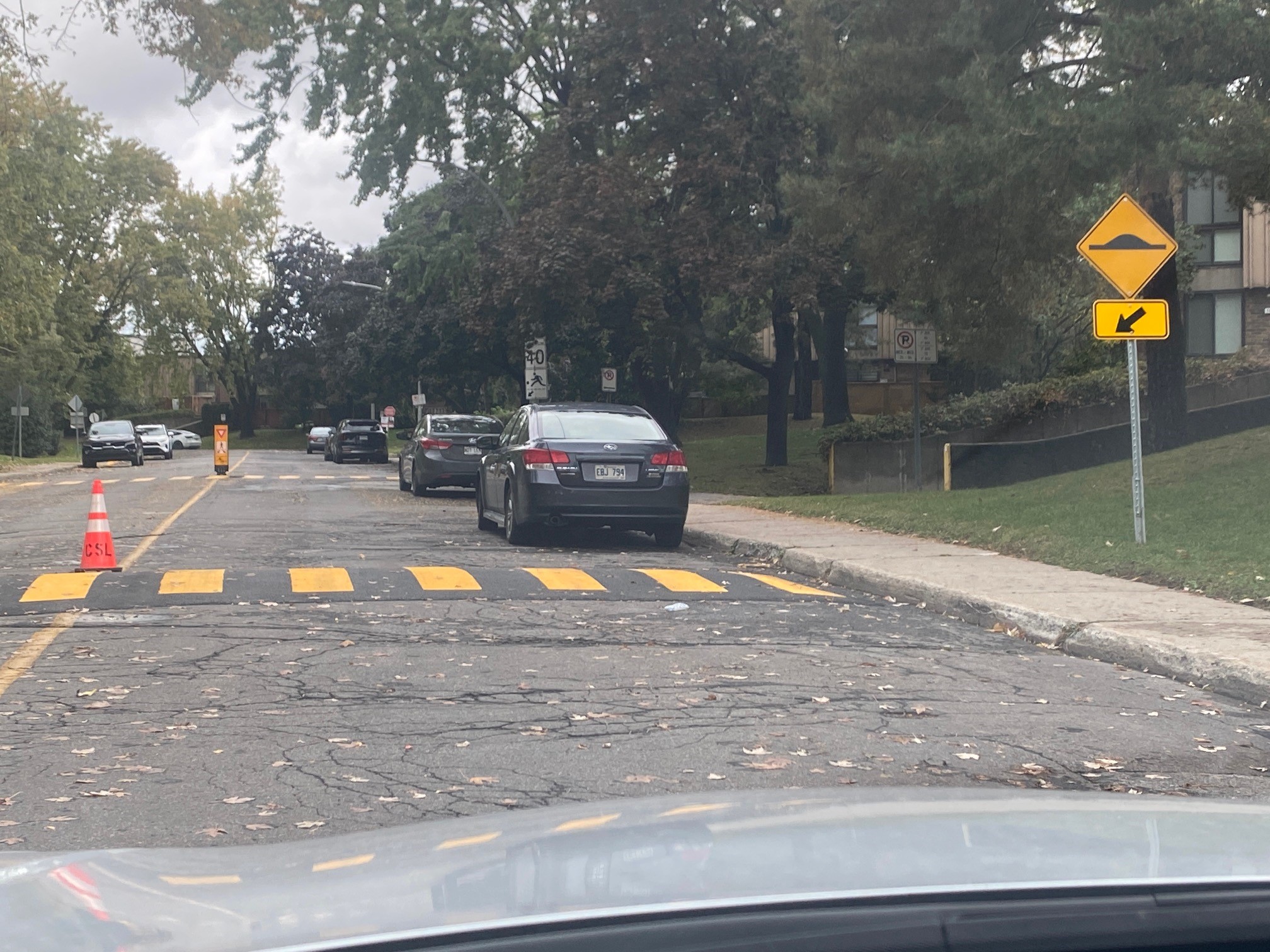
Speed humps or bumps are not approved easily by our Traffic Committee. A lot of research goes into these decisions. This includes site visits and an analysis of the traffic.
Speed humps are installed to reduce the speed of traffic, spaced evenly along a block, 50 to 90 metres apart, and are usually located 10 to 30 metres from an intersection. There is no question we have had vehicles moving too fast, notably when they make the turn at the curve from Rembrandt,
In the case of Merrimac, it was decided to make this an elevated crosswalk. This ensures that cars are slowing down at the instant pedestrians may be crossing, hence it is the safest. “If we install a speed hump next to a crosswalk, it is not ideal as cars tend to accelerate after passing the hump towards the crosswalk,” emphasizes our Traffic Engineer Spyro Yotis.
The hump will be in place 12 months a year.
Our Traffic Engineer will analyze the success of this measure next spring.
Les ralentisseurs sont installés pour réduire la vitesse
Depuis de nombreuses années, les habitants de l'avenue Merrimac réclament un ralentisseur. Je tiens à saluer tout particulièrement les résidents Arthur Cytrynbaum et Gregory Libman, car un ralentisseur a été installé au début du mois d'octobre en face de l'entrée du parc Rembrandt.
Les ralentisseurs ne sont pas approuvés facilement par notre commission de la circulation. Ces décisions sont le fruit de nombreuses recherches. Elles comprennent des visites sur le terrain et une analyse du trafic.
Les ralentisseurs sont installés pour réduire la vitesse de la circulation. Ils sont espacés régulièrement le long d'un pâté de maisons, de 50 à 90 mètres, et sont généralement situés à une distance de 10 à 30 mètres d'une intersection.
Dans le cas de Merrimac, il a été décidé d'en faire un passage piéton surélevé. Cela permet de s'assurer que les voitures ralentissent au moment où les piétons traversent, et c'est donc la solution la plus sûre. "Si nous installons un ralentisseur à côté d'un passage pour piétons, ce n'est pas l'idéal car les voitures ont tendance à accélérer après avoir passé le ralentisseur en direction du passage pour piétons", souligne Spyro Yotis, ingénieur en charge de la circulation.
Le ralentisseur sera en place 12 mois par an.

