
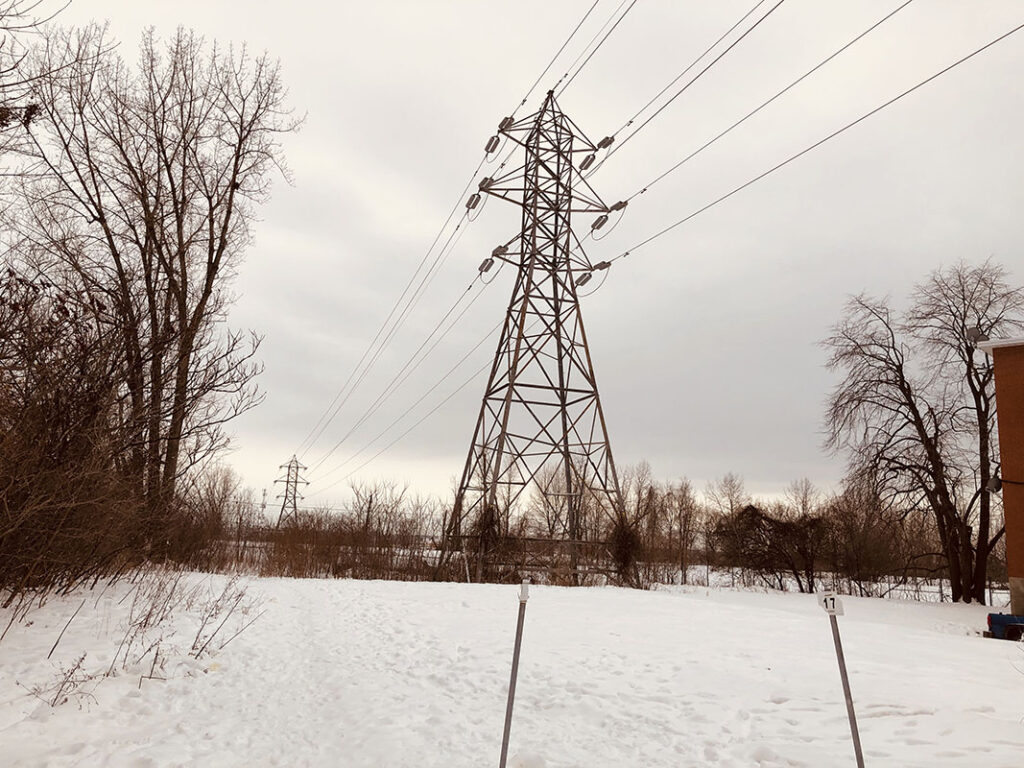
District 2 in Côte Saint-Luc will be part a major electrical system upgrade of the Hydro-Québec network. Work will occur between 2023 and 2026 and impact homes on Merrimac Road, Marc Chagall Avenue as well as Bialik High School
Hydro will be converting three 120-kV substations to 315 kV. This includes the Hampstead substation (in Côte Saint-Luc) and rebuilding the 120-kV Aqueduc-Saraguay overhead transmission line at 315 kV over a span of 18 km between LaSalle and Saint-Laurent. Known as the Aqueduc-Saraguay project, the cost is estimated at over $500 million. The project involves replacing aging equipment, maintaining the system’s reliability, meeting future electricity needs and supporting economic development.
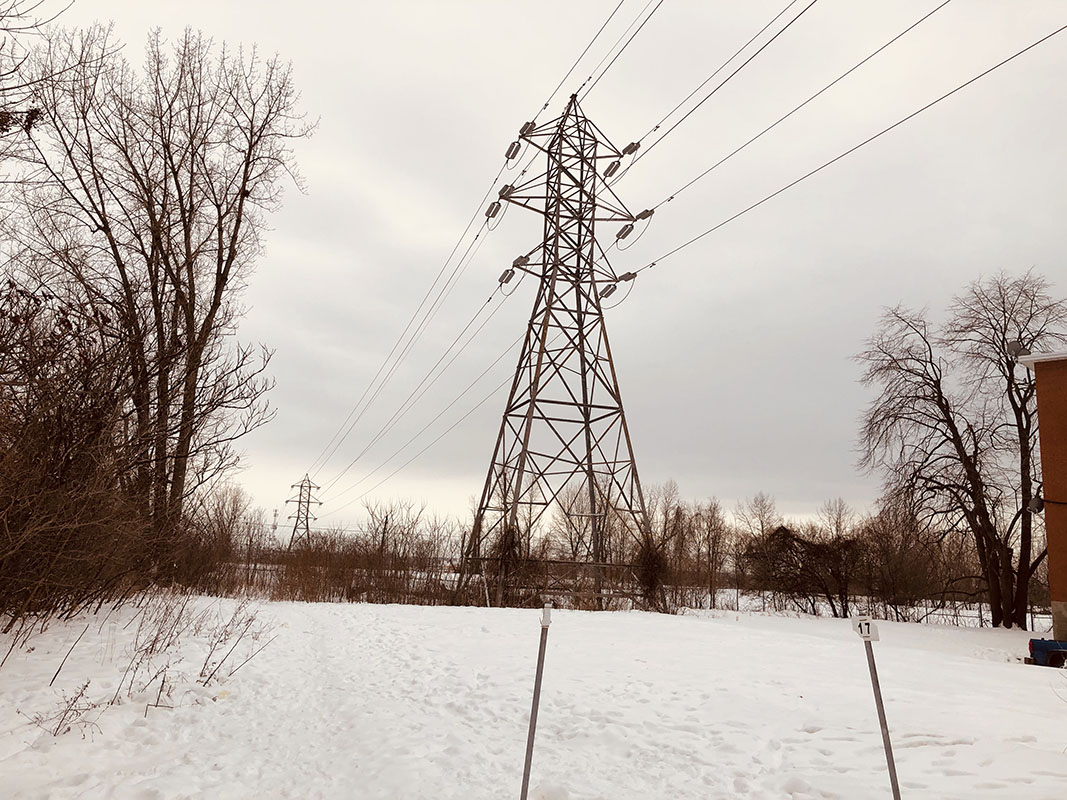
Both Hydro and Côte Saint-Luc did a study related to what the level of Electromagnetic fields (EMF) will be, that being a combination of invisible electric and magnetic fields of force. They occur both naturally and due to human activity. Hydro’s study showed that the EMF’s will be within the norms. Our investigation confirmed that. Councillor Steven Erdelyi, who co-chairs this committee with Councillor David Tordjman, told me: “On the positive side when you increase the voltage, you decrease the current. That means less magnetic field so it is actually safer for people.”
There are valid reasons for this work. Despite the fact people are becoming more energy efficient, power consumption is up and more people are purchasing electric cars. In District 2 alone we just added two large Equinoxe towers. Not far off, the former Blue Bonnets Raceway will become the base to some 5,000 housing units.
A joint working committee of representatives from Hydro-Québec, the City of Côte Saint-Luc and a few members of the public started work January 27, 2020 to address public concerns about the Aqueduc-Saraguay project. The committee’s mandate has been to review how Hydro-Québec can implement the project in Côte Saint-Luc while minimizing its impacts. For example, the committee is to assess how greenspaces can be enhanced.
The COVID-19 pandemic has had a significant impact in terms of slowing down the process. We had two meetings in February and then had to wait until October before we convened again. Right now we must finalize with Hydro the precise trajectory of the new towers. There will be at least 12 towers constructed in Côte Saint-Luc and this entire project will take over a decade to complete. We also have questions about noise and public safety we need answered.
I asked two residents, Charles Guerin from the Meadows and Glenn J Nashen (on behalf of JPPS-Bialik) to be part of the committee. Hydro has been asked a lot of very detailed questions from the city and committee members. It is hoped these deliberations can be concluded in February or March because we as a city have not yet shared a comprehensive look at the project for the community at large.
In fact only last June Hydro stated: “By the end of the year, an information and consultation meeting will be held to present the project. The public will be invited to provide feedback and comments on the committee’s work and present other ideas of how the project could be improved.”
Again, none of us thought that we would still be dealing with the pandemic in 2021 at this emergency level.
Complicating matters further has been the launch on January 25 of a series of focus groups organized by Hydro. I was part of the first session. To me, this is an example of placing the cart before the horse. As the committee proceeds, residents who have no information on the actual project are suddenly being asked for their opinions to obtain a portrait of the usage of the transmission line right-of-way. The objective is to collect the residents' ideas and concerns regarding the future right-of-way and its potential use.
I felt badly for the Hydro personnel and consultants who were asked to organize these sessions. They were there to talk about how to beautify greenspace near the new towers. Naturally, Meadows residents who were on the call wanted to know details. ”How big will the towers be? Has an environmental assessment been made?” These are the type of questions residents had on their minds. But this was not the right table to ask them. This Hydro team wanted to know what residents would like the greenspace to look like. These type of focus groups should have started first with experts detailing the main project, with this coming after.
THE RIGHT OF WAY
What is a right-of-way? It is a legal agreement that allows Hydro access to the property directly beneath and to either side of an electric power line. Also called an easement, the right-of-way allows them to enter the property at any time, to perform maintenance or repairs to their equipment.
Hydro officials say they want to develop the hydroelectric right-of-way that meets the needs of the community: community gardens, playgrounds, swings, landscaping, etc. Their goal is to improve the environment and the quality of life of the people who own this right of way. In recent weeks I have been hearing from very confused constituents on Merrimac and Marc Chagall who want more information. I communicated again with the committee chairs in the last few days and asked them to please do everything they can to move this process along.
Please understand. This is an island-wide project and it will go ahead, regardless of any protests. Hydro does not need our permission.
Another Hydro project which directly impacts the upgrading of wiring at the Meadows has been delayed for several years because it involves the exchange of certain servitudes. The Meadows did have some say in that matter, but keep in mind that the condo property is supported by very old equipment and we may pay the price for this.
UNDERGROUND VS. OVERHEAD
So When does Hydro opt for underground lines? Hydro responds as follows: “Whenever it’s impossible to build an overhead line because of insufficient space or an impassable obstacle such as a building.”
The cost for overhead lines, with a service life of 85 years, is $150 million. Hydro maintains it will have greater transmission capacity and a faster recovery from outages. An underground line, it points out, has a service life of 40 years, a lower transmission capacity and it is more complicated to maintain and repair. Oh yes, the cost is $440 million
Hydro-Québec’s transmission system, like all other transmission systems in the world, is mainly an overhead one. Out of 34,000 km of lines, they say only 200 km (0,7 percent) are underground, and those are mainly in downtown areas.
They give examples of the percentage of underground power lines with a voltage of 315 kV and higher in some other places: 0.1 percent in Canada; 0.4 percent in the United States; 0.4 percent in Germany; and 0.8 percent in Japan
Since underground lines are more expensive, Hydro says they’re used only in places where an overhead line can’t be built, either for lack of space, as in downtown Montreal, or because of an impassable obstacle like a building.
The costs of an underground line are determined by a set of variables that have to be analyzed for each project. For this project, a 315-kV underground line would cost about $290 million more, nearly three times more than an overhead line.
Since Hydro-Québec’s investment choices have a direct impact on electricity rates for all of its customers, the company says it has an obligation to choose the lowest-cost option.
Last but not least, Hydro states, an overhead line can carry more electricity than an underground line.
Here is how Hydro sums up choosing the optimal course of action: they have a duty to submit the best possible project, one that is technically, economically, environmentally and socially sound and that benefits its customers; performs well from a technical perspective; can be carried out at the best possible cost; respects the environment; and safeguards the public interest and that of its customers
Hydro maintains building a 315-kV overhead line is the best option. They also emphasize that an overhead line follows a single route. An underground line could be completely different from that of the existing line. An overhead-underground junction substation might also have to be built for an underground line: for a 315-kV line, that would be quite sizable. Building an underground line would have some major impacts: laying two separate ducts (under the streets alongside the existing right-of-way). Undergrounding a transmission line is more complex and takes longer.
The consensus does seem to be that we might be better off health-wise with the overhead wires.
The latter is true. But these towers will not impact our entire city of 34,000 residents so we do not have strength in numbers. Nonetheless, via these focus groups it is hardly futile to go on record with our concerns.
Furthermore, we can continue to make the argument for underground wiring. But unless we as a city pay for the work, Hydro does not have to agree. Their strategy has been shared with you in detail up above. Our annual budget for the entire city is $75 million. Underground work would cost $440 million, so we can all do the arithmetic.
THE TOWERS
The towers presently contain an overhead transmission line operating at 120 kV. They will be dismantled and rebuilt at 315 kV. The exact route of the line is currently under study and the subject of consultations with the special committee. I met via Zoom with Meadows residents for nearly an hour and a half and clearly everyone would to see the present-day large tower moved somewhere else, like behind the JPPS-Bialik field. Is that possible? It certainly will be raised at our special committee level.
HAMPSTEAD SUBSTATION
The Hampstead substation located behind Mount Sinai Hospital was built in 1955. The electricity supplies residences, businesses and industrial customers in Côte Saint-Luc, Hampstead, Montreal West Côte-des-Neiges–Notre-Dame-de-Grâce and Lachine via the distribution system. As part of the project, new 315-kV equipment will be installed at Hampstead substation.
HYDRO-QUÉBEC: PROJET AQUEDUC-SARAGUAY (Source, Hydro-Québec)
Afin de répondre aux besoins croissants en électricité du secteur, Hydro-Québec investira plus de 500 M$ pour moderniser son réseau de transport dans l’axe nord-sud de l’île de Montréal, entre les arrondissements de Saint-Laurent et de LaSalle. Les équipements du réseau sont vieillissants, et doivent être remplacés.De plus, ce projet vise à améliorer la fiabilité de l’alimentation en électricité et la continuité du service à long terme pour tous les résidents de la région.
Hydro-Québec ajoutera environ 500 MW de puissance afin d’appuyer le développement économique et social dans les secteurs d’activité suivants :
- Projets immobiliers, résidentiels et commerciaux ;
- Projets de transport en commun (p. ex. station du Réseau express métropolitain (REM) et garages de la Société de transport de Montréal (STM) pour la recharge de bus électriques) ;
- Projets de développement manufacturier ;
- Centres de données et serres.
500 M$ investis
500 MW de puissance prévue
18 km de ligne de transport à convertir
3 postes à convertir
Modernisation du réseau électrique entre les postes de l’Aqueduc et de Saraguay
Le projet prévoit :
- la reconstruction à 315 kV de la ligne de transport aérienne existante à 120 kV à sur 18 km entre Saint-Laurent et LaSalle. La ligne sera reconstruite dans l’emprise actuelle, mais dans le cadre des étapes suivantes, le tracé pourrait être optimisé pour en atténuer les impacts selon des critères techniques, économiques, environnementaux et sociaux.
- la conversion de trois postes de transformation de 120 kV à 315 kV, soit les postes Rockfield (à Lachine), de Hampstead (à Côte Saint-Luc) et Laurent (à Saint-Laurent).
Hydro-Québec procède aussi à une étude préliminaire en vue de construire un nouveau poste dans le secteur de Dorval et la ligne d’alimentation associée.
Le projet se réalise dans une emprise de ligne en milieu urbain densément occupée à plusieurs endroits. Dans un souci d’harmoniser son projet avec la vision du développement de ses partenaires municipaux, Hydro-Québec mène une démarche afin de travailler en collaboration avec les villes et arrondissements, les organismes et les résidents concernés.
La ligne projetée sera construite dans une emprise de ligne existante où se trouve déjà une ligne aérienne de transport d'électricité à 120 kV.
Quand opte-t-on pour une ligne souterraine ?
Où il s'avère impossible de construire une ligne aérienne parce que l'espace est insuffisant ou parce que s'y trouve un obstacle infranchissable (p. ex. bâtiments, commerces)
LIGNE AÉRIENNE
- Durée de vie : 85 ans
- Capacité de transit supérieure
- Rétablissement plus rapide en cas de panne
Coût
~150 M$*
LIGNE SOUTERRAINE
- Durée de vie: 40 ans
- Capacité de transit inférieure
- Entretien et réparation plus complexes
Coût~ 440 M$*
Une ligne souterraine coûterait environ 290 M$ de plus qu'une ligne aérienne, ce qui aurait un impact sur les tarifs d’électricité pour tous les Québécois.
Ligne souterraine : mesure d’exception
- Comme c’est le cas partout dans le monde, le réseau d’Hydro‑Québec est essentiellement aérien. Sur 34 000 km de lignes de transport, l’entreprise ne compte que 200 km, soit environ 0,7 %, de lignes souterraines, essentiellement dans les centres-villes.
- Voici des exemples de pourcentage de lignes de transport à 315 kV et plus qui sont enfouies ailleurs :
- 0,1 % au Canada
- 0,4 % aux États-Unis
- 0,4 % en Allemagne
- 0,8 % au Japon
- Étant donné son coût plus élevé, une ligne souterraine est envisagée seulement là où il est impossible de construire une ligne aérienne, soit parce que l’espace est insuffisant (par exemple au centre-ville de Montréal) ou parce qu’il y a un obstacle infranchissable (par exemple des bâtiments imposants).
Coûts, durée de vie et capacité de transit
- Les coûts d’une ligne souterraine sont fonction d’un ensemble de variables qu’il faut analyser pour chacun des projets.
- Dans ce cas-ci, les coûts paramétriques de la ligne souterraine à 315 kV seraient d’environ 290 M$ plus élevés, ce qui représente trois fois les coûts d’une ligne aérienne de la même capacité. La ligne aérienne devrait coûter quelque 150 M$ alors que la ligne souterraine coûterait approximativement 440 M$ en dollars courants de 2018.
- Hydro‑Québec se doit de présenter l’option la moins coûteuse possible, puisque ses choix influent directement sur les tarifs d’électricité pour l’ensemble de la population québécoise.
- La durée de vie d'une ligne aérienne est d’environ 85 ans tandis que celle d’une ligne souterraine est d’environ 40 ans. Puisqu’il faut que le réseau reste sous tension pendant la reconstruction, il faut prévoir repartir de zéro après 40 ans dans le cas d’une ligne souterraine. Les coûts paramétriques de la construction d’une ligne souterraine ne comprennent pas les coûts de reconstruction après 40 ans.
- Enfin, une ligne aérienne peut faire transiter plus d’électricité qu’une ligne souterraine.
Hydro‑Québec a le devoir de présenter la meilleure option qui soit, sur les plans technique, économique, environnemental et social, et ce, pour le bénéfice de sa clientèle. Hydro‑Québec doit donc présenter un projet :
- performant du point de vue technique ;
- au meilleur coût possible ;
- respectant l’environnement ;
- en préservant l’intérêt du public et celui de la clientèle.
- Le projet retenu constitue le point d’équilibre entre ces grands critères. Dans le cas présent, les études montrent que la construction d’une ligne aérienne à 315 kV constitue la meilleure option respectant ces critères.
Impacts et réparation
- Si elle est aérienne, la ligne n’emprunte qu’un seul tracé. Si elle est souterraine, pour des raisons de fiabilité du réseau, il faut que les deux circuits qui la composent soient séparés donc, idéalement, qu’ils suivent des rues différentes. Ces tracés divergeraient complétement du tracé de la ligne existante.
- Une ligne souterraine pourrait aussi nécessiter la construction de postes de liaison aérosouterraine : pour une ligne à 315 kV, il s’agit d’équipements imposants.
- La construction d’une ligne souterraine comporterait des impacts importants : mise en place de deux canalisations distinctes (dans les rues qui longent l’emprise existante), en plus de baies de jonction à intervalles d’environ 500 à 800 m.
- Les réparations d’une ligne souterraine sont plus complexes et les délais sont en conséquence plus longs.